
I’ve owned a Vitamix since 2016. Loved the thing. Evangelized it to friends. When I was planning a move to Ireland in 2020, I gave it away to someone who’d appreciate it.
The move didn’t happen. So I bought a new one — a Vitamix 5200. Four hundred bucks. The gold standard of blenders, right?
Within a month, I knew it was defective.
I’d put anything in it — fruit, ice, whatever — turn it on, and within seconds the thermal overload protection would trip. Dead. Done. Fifteen to twenty minutes of cooling before I could try again. This is a 2.2 horsepower motor. My first car had less power. And it can’t blend a banana without having a panic attack?
I sent it back. Vitamix sent me a replacement. Same exact problem.
So for five goddamn years, I have been hauling this useless brick from Massachusetts to Washington state, house to house, move to move. Taking up space in boxes, on counters, in cabinets. Mocking me. A $400 paperweight that I was too stubborn to throw away and too annoyed to deal with.
This morning I decided: enough. I called Vitamix ready to drop serious money on their commercial line. Because clearly consumer Vitamix had gone to shit.
The woman who answered — patient, professional, probably used to dealing with idiots — asked me to describe the problem. I told her everything. In detail. Honestly.
“How are you using it?” she asked.
“I turn it on at a low speed and blend.”
Pause.
“Yeah, you can’t do that.”
Apparently — and I cannot stress enough how stupid this is — the correct way to operate a Vitamix 5200 is: turn it on at low speed, crank to high within five seconds, flip the switch from Variable to High, flip it back to Variable, then set whatever speed you actually want.
That’s not a startup procedure. That’s a ritual. That’s what you do to summon a blender demon.
Miss a step and the motor draws too much current under load at low RPM, overheats, and shuts itself off to protect its precious windings from your smoothie.
“Did you read the manual?” she asked.
No. No I did not read the manual for a blender. I’ve been using blenders since 2017. You turn it on, you blend. That’s the social contract between man and blender.
I tried her method. It worked flawlessly.
Then — because I’m a masochist — I found the manual and read it. It’s in there. Clear as day.
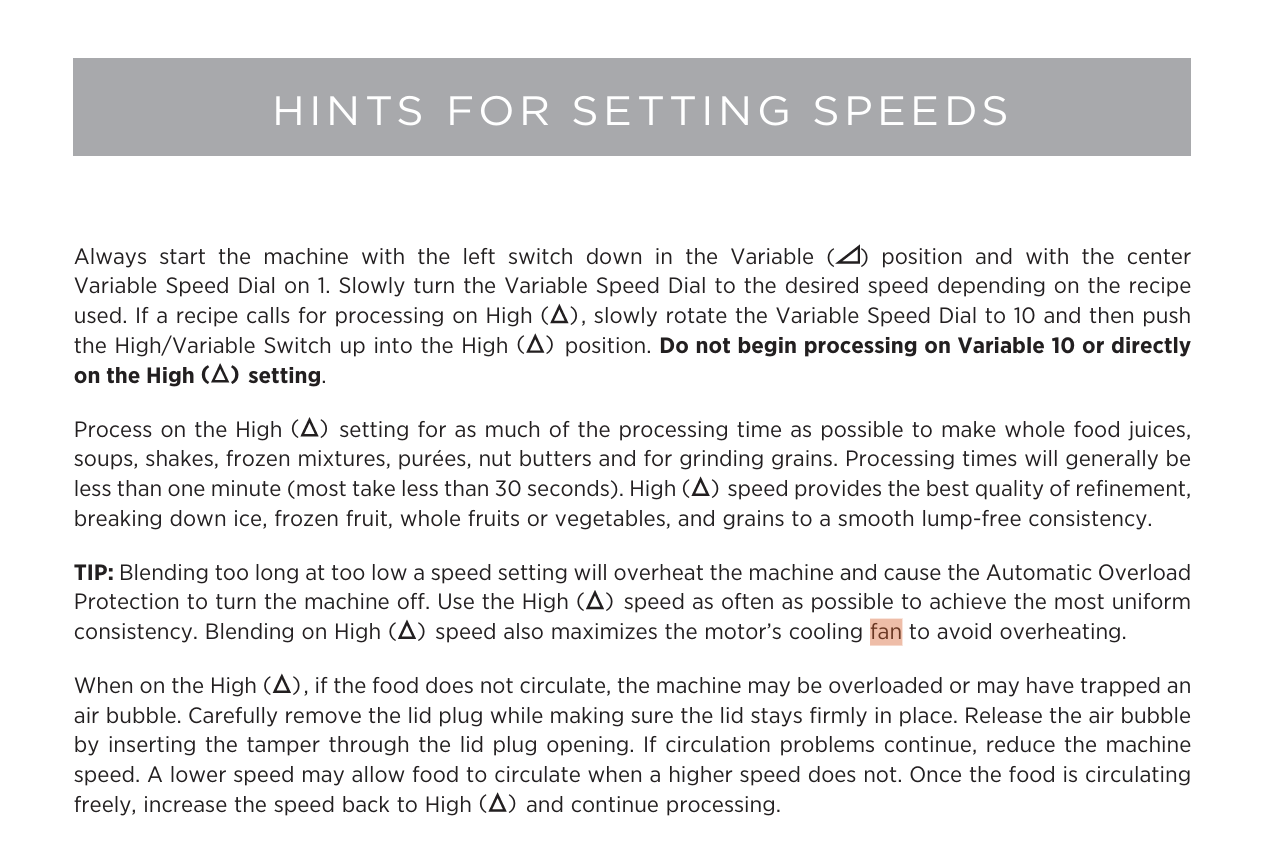
The word “fan” appears once in the entire document, right there in the section explaining the thermal protection system and how to not trigger it.
Five years. Five years of carrying around a “broken” blender. Two support tickets. One replacement unit. All because I didn’t read twelve pages of instructions for an appliance that has one job.
But here’s where I refuse to fully accept the blame.
If you are an engineer — and I am one, which makes this doubly painful — and you design a household appliance that requires a non-obvious five-step startup sequence to avoid thermal shutdown, you have failed. Full stop. “It’s functioning as designed” is not a defense. It’s an indictment. You designed a blender that, when used the way every single human being on earth would intuitively use a blender, breaks itself. And your solution is a paragraph on page 7 of a manual that nobody reads?
Put a sticker on the jar. Make the dial click. Add a light that says “SPEED UP, DUMMY.” Engineer the problem out. Don’t write documentation around a trap and call it a feature. You know what my old Vitamix did? You turned it on and it blended. Revolutionary concept.
Both things are true. I should have read the manual. That’s on me. And Vitamix should build a blender that doesn’t require a blood oath to operate without self-destructing. That’s on them.
But at least I don’t need to buy a new one. Five years late, the $400 blender finally works.
One last thing. To the woman at Vitamix customer service whose name I didn’t catch: thank you.
You solved in three minutes what I’d been angry about for five years. You didn’t condescend. You didn’t read from a script. You asked the right questions, listened to my answers, and told me plainly what I was doing wrong. In a world of chatbots and phone trees and “have you tried turning it off and on again,” a real human being who actually knows the product and gives a damn is worth celebrating. Good old-fashioned customer service still exists, if you’re lucky enough to find it.
- RTFM, people. RTFM.
- Engineer better products.
- And don’t replace your invaluable customer service person with a useless bot.


“It’s functioning as designed” is not a defense. It’s an indictment. – this lesson hits hard and deep, when I read it as a product creator. I feel vindicated when I read it as an aggrieved user.
I had the great fortune of working with Amrith during my formative years in product creation. On a certain night shift, as I struggled to get a piece of code working, I heard a stern voice behind almost hollering ‘RTFM Venkat’. Looking behind, I saw an imposing Amrith quite displeased with my trying to battle it out with the keyboard and the terminal in silly trials and errors. His sternness got replaced with amusement when I naively muttered – But, tell me Amrith, what is RTFM?
I have since then quoted this anecdote in many of my team development interactions. RTFM is the mantra for my technical colleagues. Regarding my users, the onus is on me to make the product NOT NEED A HELP MANUAL.
Thanks Amrith for a great post, written with candor and finesse!
LikeLike