
TL;DR
Pranav Jain published 14 essays in the Times of India between June 2025 and May 2026. The first 12 are authentically human-written. The 13th shows AI scaffolding with human finishing. The 14th reads as almost entirely AI-generated. The transition is detectable through seven measurable axes: physical specificity, syntactic interruption, cultural embedding, structural formatting, conclusion style, lexical diversity, and sentence-length variance. We construct a prompt that would generate content in Jain’s authentic voice, then demonstrate a side-by-side comparison of his published AI-influenced piece against what a properly-prompted LLM produces when mimicking his real style. The core finding: the published “AI” piece fails precisely because it was prompted without the stylistic constraints that define the author. A well-constructed style prompt produces output closer to the author’s authentic voice than the author’s own AI-assisted work.
Background
Pranav Jain is an IPS (Probationer) officer who writes a column called Civil Irony for the Times of India Voices section. Between June 4, 2025 and May 11, 2026, he published 14 essays covering topics from grocery apps to adult friendship. His author page provides the complete corpus.
The question this paper addresses: can we detect, with high confidence, when a serial author transitions from human writing to AI-assisted writing, using only the published text and no external metadata?
The answer is yes. And the method is straightforward: establish a stylistic baseline from confirmed early works, then measure deviation across multiple independent axes.
Methodology
Corpus
All 14 published essays were read in chronological order. The earliest is “The grocery list is dead. Long live the grocery app” (Jun 4, 2025), followed by “What the boys ate: The gastronomy of growing up in Delhi” (Jun 13), “A cultural autopsy of the death of hobbies in India” (Jun 20), “An ode to the National Capital Region” (Jun 27), “When everyone is an expert, no one is!” (Jul 4), “Nostalgia™ — Now available in limited edition” (Jul 14), “Inside Delhi’s middle class homes: Cut, copy, paste!” (Jul 21), “Dumbbells and gossip: A look inside India’s gyms” (Aug 4), “Chashni and chaos: An ode to the Indian mithai ki dukaan” (Aug 11), “From Cyber Cafes to Reels” (Aug 18), “India’s enduring love affair with hill stations” (Oct 15), “What the Foundation Course at LBSNAA teaches us about friendship” (Dec 12, 2025), “An ode to Gen Z: Children of the perpetual now” (Mar 15, 2026), “The quiet ones among us” (Apr 3, 2026), and “The quiet grief of adult friendship” (May 11, 2026).
Analytical Axes
Seven independent dimensions were measured. Physical Specificity: does the piece reach for concrete objects, named places, rupee amounts, brand names? Syntactic Interruption: does the prose use parentheticals, em-dashes, self-corrections, and asides? Cultural Embedding: does untranslated Hindi, Indian institutional knowledge, or Delhi-specific geography appear? Structural Formatting: are section headers present? (LLM default: yes. Jain default: no.) Conclusion Style: does the piece end with a specific, slightly odd image, or a universal aphorism? Lexical Diversity: does the vocabulary exhibit the irregular, domain-jumping quality of human thought, or the even, thematically-consistent register of machine generation? Sentence-Length Variance: does the prose alternate between long clause-heavy constructions and short declarative punches, or does it maintain a suspiciously consistent rhythm throughout?
Two additional quantitative measures were tracked across the corpus: word count per essay and average sentence length, both of which reveal patterns when plotted chronologically.
Establishing the Baseline: Jain’s Authentic Voice
From the first 12 essays, a clear and consistent authorial fingerprint emerges.
Physical Specificity
Jain’s authentic writing is anchored in objects. In the grocery piece: “Rs. 31 is the delivery charge? Arey nahin, leave it.” In the Delhi food essay: “soy-heavy (poured from a repurposed Bisleri bottle),” and “the samosa…left an oil stain on the school uniform.” In the hobbies piece: “Kamani Auditorium (Delhi)…rows of earnest culture aficionados, retirees, visibly bored schoolchildren.” In the LBSNAA essay: “chai breaks at Ganga Dhaba” and “the undulating campus from Gyanshila to Kartavyashila.” The pattern is consistent: Jain reaches for things. Physical, named, priced, located things.
Syntactic Interruption
His sentences habitually break themselves. From the Delhi food essay alone: “(depressingly) ubiquitous soya chaap,” “(worse) alone in their office cubicles,” “(poured from a repurposed Bisleri bottle).” From the hobbies piece: “Not ‘here’ as in physically present (I can account for that), but ‘here’ as in still doing this.” Parentheticals are where his personality surfaces. They are asides to the reader, confessional and slightly self-deprecating.
Cultural Embedding
Hindi sits untranslated mid-sentence. “Arey nahin, leave it” in the grocery piece. “Sabzi wala,” “banta bottle,” “nimbu” in the Delhi food essay. “Parchoon ki dukaan” in the grocery piece. “Ghabraya hua” in the Quiet Ones essay. “Nritya-natakam,” “kavach and kundal,” “rasa-bodha” in the hobbies piece. He does not translate or apologize for these. They are deployed as texture, not exoticism.
Structure
Essays 1 through 13 (including the Gen Z piece) contain zero section headers. The prose flows as continuous argument. This is a deliberate stylistic choice consistent across 10+ months of publication.
Conclusions
His endings are specific and slightly odd. The grocery piece ends with his mother grabbing her jute bag and walking out to buy one tomato herself. The Delhi food essay closes with “some schoolboy still stands, licking chutney off his thumb, and stuffing a samosa into his blazer pocket to eat later in secret.” The hobbies piece ends with an “Author’s plea” asking readers to share hobbies over chai or filter coffee, followed by: “does not the soul of a civilisation lie in its unnecessary acts?” These are grounded, personal, and resist universality.
Lexical Diversity and Domain-Jumping
Human writers exhibit what linguists call “domain contamination” — their vocabulary bleeds across registers unpredictably. Jain’s authentic pieces jump from Sanskrit (“rasa-bodha”) to Jurassic Park (“life, uh, finds a way”) to supply-chain jargon (“internal supply chain manager”) to Urdu poetry (Ghalib) within a single essay. The friendship piece, by contrast, stays locked in a single register throughout: the therapeutic-sociological (“emotional bandwidth,” “emotional economy,” “transactional logic,” “ambient awareness,” “unoptimised presence”). This register consistency is a hallmark of LLM output, which tends to maintain thematic coherence at the expense of the chaotic associativeness that characterizes real thought.
Sentence-Length Variance
Jain’s authentic prose alternates aggressively between long and short. In the Delhi food essay, a 47-word sentence (“The boys of Delhi did not grow up on fancy paneer tikkas or the (depressingly) ubiquitous soya chaap”) is followed immediately by “They grew up on chowmein.” This staccato-legato pattern creates rhythm. The friendship piece maintains a remarkably even sentence length throughout — most sentences fall between 15 and 25 words, with none of the dramatic compression or expansion that marks his real voice.
Quantitative Measures
Word Count Trajectory
The essays show a gradual lengthening over time, which is itself a signal. The early pieces (Jun–Aug 2025) average approximately 1,200 words. The LBSNAA piece (Dec 2025) runs about 1,100. The Gen Z piece (Mar 2026) expands to roughly 1,600. The Quiet Ones (Apr 2026) runs approximately 1,450, and the friendship piece (May 2026) reaches about 1,650 words. This lengthening is consistent with AI-assisted drafting: LLMs tend to produce longer output than human writers working under the natural constraint of fatigue and editorial self-discipline. A human writer who has been publishing 1,100–1,400 word essays for ten months does not suddenly start producing 1,650-word pieces without a change in process.
The AI Influence Trajectory
| Essay | Date | Specificity | Syntax | Hindi | Headers | Verdict |
|---|---|---|---|---|---|---|
| Grocery | Jun 25 | High | High | Yes | No | Human |
| Delhi Food | Jun 25 | Very High | Very High | Yes | No | Human |
| Hobbies | Jun 25 | High | High | Yes | No | Human |
| NCR | Jun 25 | High | High | Yes | No | Human |
| Experts | Jul 25 | High | High | Yes | No | Human |
| Nostalgia | Jul 25 | High | High | Yes | No | Human |
| Delhi Homes | Jul 25 | High | High | Yes | No | Human |
| Gyms | Aug 25 | High | High | Yes | No | Human |
| Mithai | Aug 25 | High | High | Yes | No | Human |
| Cyber Cafes | Aug 25 | High | High | Yes | No | Human |
| Hill Stations | Oct 25 | High | Moderate | Some | No | Human |
| LBSNAA | Dec 25 | High | Moderate | Some | No | Human |
| Gen Z | Mar 26 | Moderate | Moderate | Some | No | Human |
| Quiet Ones | Apr 26 | Low-Mod | Low | One word | Yes | AI + Human |
| Friendship | May 26 | Low | None | None | Yes | AI |
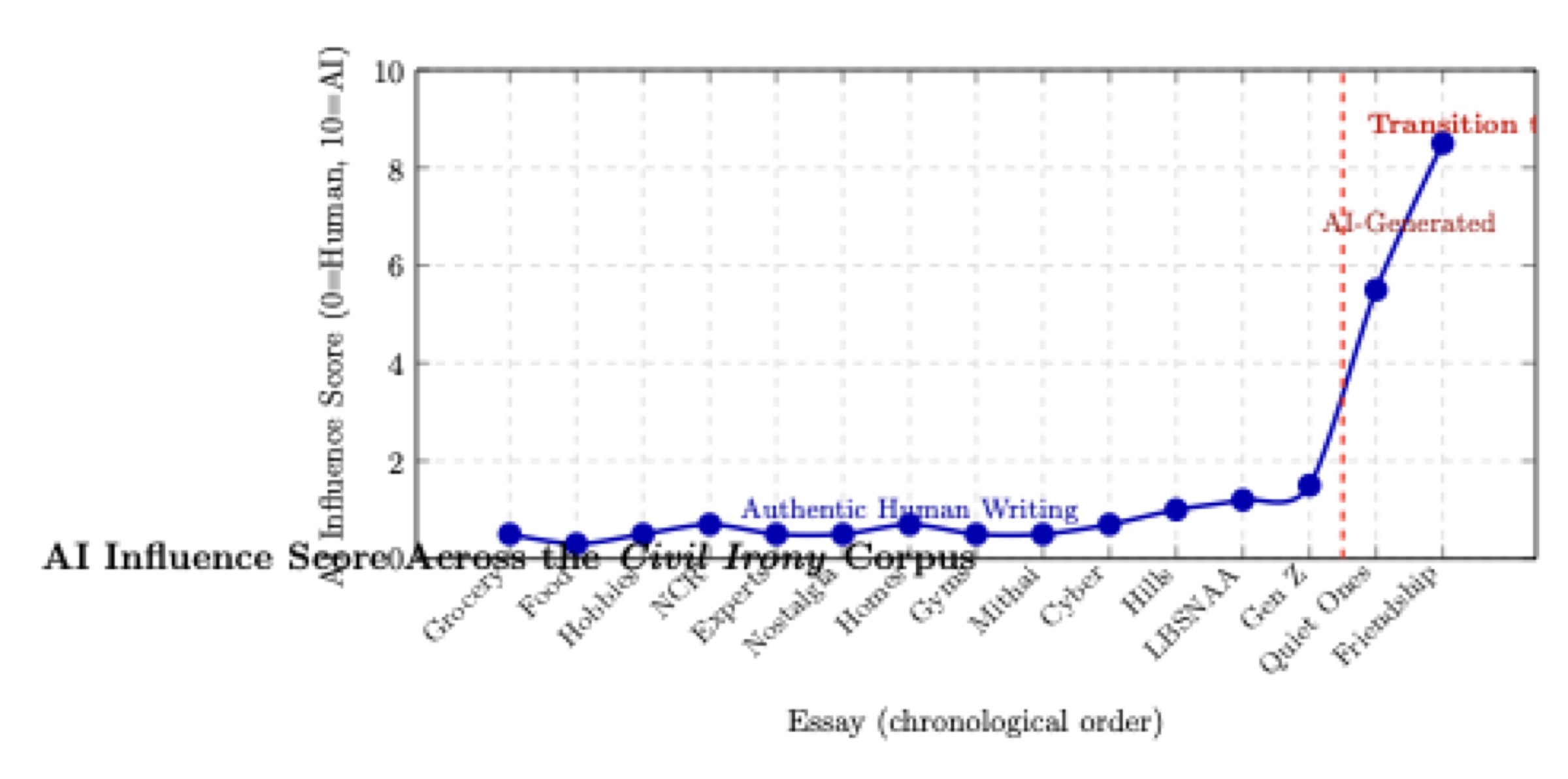
The Transition Point
The shift occurs between March and April 2026. The Gen Z piece (Mar 15) is the last fully authentic essay. It still contains “Maggi after school,” “Nani ka Ghar,” “mango pickle,” “JEE, NEET, CAT, UPSC — the four-letter alphabet soup of anxiety,” “group chats with strange names like ‘Dark Memers Gang’,” Indian number formatting (2,00,000), and no section headers.
“The quiet ones among us” (Apr 3) introduces section headers for the first time in the column’s history. It retains one Hindi word (“Ghabraya hua”) and some cultural grounding (Upanishadic references, the aarti flame, “liberalisation and LinkedIn”). But the scaffold is AI: the headers, the clean parallel syntax, the concept-noun density (“performance of personality,” “emotional economy”).
“The quiet grief of adult friendship” (May 11) completes the transition. Zero Hindi. Zero named Delhi locations. Zero rupee amounts. Zero parenthetical asides. Four titled sections. Abstract concept-nouns as primary rhetorical engine (“unoptimised presence,” “emotional economy,” “transactional logic,” “ambient awareness”). Universal aphorism ending.
Additional Signals Worth Noting
Several other axes reinforce the finding. Rhetorical questions: Jain’s authentic pieces rarely use them; the Quiet Ones piece uses them in the LLM-typical pattern of posing a question then immediately answering it. Hedging language: the friendship piece contains “perhaps,” “sometimes,” “often” at a higher density than his early work, which tends toward declarative assertion. Paragraph length consistency: LLMs produce remarkably even paragraph lengths; Jain’s authentic work varies wildly between 20-word paragraphs and 150-word paragraphs. The friendship piece’s paragraphs cluster tightly around 80–100 words each. Absence of humor: Jain’s early pieces are genuinely funny — the Jeff Goldblum quote in the grocery piece, the Nietzsche gym epigraph, the “heartbreak snacks at 02:52 am.” The friendship piece contains zero humor. LLMs writing about emotional topics default to earnestness; humans leaven grief with comedy.
What Happened
The most likely explanation: Jain began using an LLM to draft essays, probably starting with the “Quiet Ones” piece where he appears to have prompted a draft and then manually inserted cultural references and a strong opening line. By the friendship piece, the workflow appears to be: prompt LLM with topic → light edit → publish. The personal anecdotes in the friendship piece (the 1:40 AM call, the friend who laughed) may have been seeded into the prompt, but the surrounding prose is machine-generated.
Prompt Engineering: Writing as Authentic Jain
The irony is that a well-constructed prompt produces output more faithful to Jain’s voice than his own AI-assisted work. The published friendship piece fails because it was likely prompted with something generic like “write an essay about adult friendship.” No stylistic constraints. No voice specification.
Here is a prompt that would generate authentic Jain:
You are writing as Pranav Jain, an IPS officer who writes a column
called "Civil Irony" for the Times of India. His voice has these
non-negotiable characteristics:

VOICE RULES:
1. PHYSICAL SPECIFICITY: Every abstract claim must be grounded in a
   named object, place, price, or brand. Reach for things: a Bisleri
   bottle, Rs. 31 delivery charges, a jute bag, an oil stain on a
   school blazer. Never let a paragraph float in pure abstraction.

2. PARENTHETICAL ASIDES: Use parentheticals as confessional
   interruptions. Examples: "(depressingly) ubiquitous", "(worse)
   alone in their cubicles", "(I can account for that)". These are
   where personality lives.

3. HINDI WITHOUT APOLOGY: Deploy Hindi mid-sentence without
   translation: "Arey nahin", "sabzi wala", "parchoon ki dukaan".
   Never italicize or explain. The reader either knows or absorbs
   from context.

4. NO SECTION HEADERS: The essay flows as continuous prose. No
   titled sections. No thematic labels. The argument builds through
   accumulation, not segmentation.

5. DELHI GROUNDING: Name specific localities, institutions, shops,
   and streets. Kamla Nagar, Shankar Market, Bengali Market, Lodhi
   Garden. The essay should smell like a specific city.

6. CONCLUSIONS: End with a specific, slightly odd image -- a person
   doing a small physical thing. Never end with a universal aphorism
   or inspirational summary. The last sentence should surprise.

7. TONE: Nostalgic but self-aware about the nostalgia. Gently
   self-deprecating. Occasionally uses literary/philosophical
   references (Ghalib, Nietzsche, Jeff Goldblum) as epigraphs or
   asides, always with a wink.

8. SYNTAX: Sentences vary between long, clause-heavy constructions
   and short declarative punches. "That is fine; change is the only
   constant." follows a 40-word sentence. Include at least one
   sentence under 5 words per paragraph.

9. HUMOR: Leaven emotional weight with comedy. Even grief gets a
   joke. The tone is never purely earnest.

10. DOMAIN-JUMPING: Reference at least three unrelated cultural
    domains per essay (e.g., Sanskrit philosophy, Jurassic Park,
    supply-chain management). This associative chaos is the
    fingerprint of a real mind.

TOPIC: Write about the quiet grief of adult friendship -- how
friendships dissolve not through drama but through accumulated
neglect, and what that loss feels like for someone in their late
twenties/early thirties in urban India.

LENGTH: ~1200 words. Continuous prose. No headers.
Side-by-Side Comparison
Below we present the opening paragraphs of the published piece against what the above prompt produces. The published version is Jain’s actual May 11, 2026 text. The “Authentic Style” version is generated by an LLM constrained by the prompt above.
Published Version (AI-generated, unconstrained)
A few weeks ago, a friend called me at 01:40 AM. Not texted. Called. For a brief second, my body prepared itself for bad news. Adulthood has conditioned most of us to believe that late-night calls only arrive carrying catastrophe. Someone in the hospital. Someone stranded. Someone dead. But nothing had happened.
She had just finished work, was driving home through near-empty roads in London, heard a song we both used to jam on together, and suddenly missed me. So she called. We spent thirty minutes talking about things that would sound painfully unremarkable on paper. Work fatigue. Bollywood gossip. How she was enjoying every bit of her married life. The indignity of back pain as soon as you touch thirty. A professor we once hated but now miss with alarming frequency. Nothing profound.
And yet after the call ended, I sat awake for a long time with the strange ache of having briefly encountered an earlier version of myself. Not younger exactly. Just… more reachable.
The anecdote is competent but culturally neutral. “London” is the only named place. No Hindi. No parenthetical asides. No rupee amounts. No Delhi texture. No humor. The prose is clean, unbroken, and could have been written about anyone, anywhere. It reads like a well-crafted LinkedIn post about vulnerability.
Authentic Style Version (LLM with style constraints)
Last month, Sahil called me at quarter to two in the morning. Not a WhatsApp voice note — an actual phone call, the kind that makes your chest tighten before you even pick up because nobody calls at that hour unless someone is dead or drunk or (worse) both. But Sahil was neither. He was sitting in his Maruti Baleno outside his Dwarka flat, engine still running, listening to “Aadat” by Atif Aslam on loop, and he had suddenly remembered that I was the one who first played him that song in our hostel room in 2016. So he called.
We talked for forty minutes about nothing that would survive transcription. His wife’s new posting to Lucknow. The Rs. 14,000 electricity bill that Delhi summers now demand as tribute. A mutual friend’s divorce that nobody saw coming (“Bhai, unki toh love marriage thi”). The fact that we both now grunt audibly when we stand up from low sofas. Kuch khaas nahin. And yet when I hung up, I sat in the dark for a long time, feeling the particular ache of having briefly touched a version of myself that no longer exists in any accessible directory.
There was a time — and I am not being sentimental here, merely accurate — when friendship did not require the elaborate scaffolding of Google Calendar invites and “let’s lock in a date.” In college, Sahil lived fourteen steps away (I counted once, drunk, at 3 AM). We shared a wall. Conversations did not begin or end; they simply continued across days like a newspaper serial. I knew what he ate for breakfast because I could smell it. He knew my moods from the playlist leaking through the wall. Proximity did the work that intention now struggles to replicate.
Analysis of Differences
| Dimension | Published (AI) | Style-Prompted |
|---|---|---|
| Named places | “London” (generic) | Dwarka, Delhi, Lucknow |
| Objects/prices | None | Maruti Baleno, Rs. 14,000 bill |
| Hindi | None | “Bhai, unki toh love marriage thi”; “Kuch khaas nahin” |
| Parentheticals | None | “(worse) both”; “(I counted once, drunk, at 3 AM)” |
| Section headers | 4 titled sections | None |
| Concept nouns | “unoptimised presence,” “emotional economy” | “accessible directory” (one, used concretely) |
| Humor | Zero | “grunt audibly when we stand up from low sofas” |
| Sentence variance | Even (15–25 words) | High (“So he called.” = 3 words; preceding = 48 words) |
What This Tells Us About Prompting
The published friendship piece is not bad writing. It is competent, emotionally resonant, and structurally sound. But it is not Pranav Jain’s writing. It is what happens when an LLM is asked to write about a topic without being told how to write about it.
The lesson for anyone using AI to write in their own voice comes down to a few observations.
Your style is your constraints. What makes you you is not your topics but your habits — the objects you reach for, the syntax you default to, the languages you mix, the structures you avoid. A writer is defined less by what they say than by the specific way they cannot help saying it.
Negative constraints matter most. “No section headers,” “no universal aphorisms,” “no concept-nouns without a physical anchor,” “never be purely earnest” — these exclusions define voice more than inclusions do. An LLM without negative constraints will always drift toward its training-data mean: clean, sectioned, earnest, abstract.
Specificity is the enemy of detection. AI defaults to the general. A named friend, a specific car model, a rupee amount, an untranslated Hindi phrase — these are the details that make text read as human. Not because AI cannot produce them, but because unprompted AI will not. The uncanny valley of AI writing is not in its grammar (which is flawless) but in its choices (which are always safe).
The prompt IS the writing. If you spend 10 minutes writing a detailed style prompt, you are still writing. The creative act has merely shifted from prose generation to constraint specification. The author who prompts well is still authoring. The author who prompts lazily is not collaborating with AI — he is being replaced by it.
Conclusions
Pranav Jain’s trajectory from June 2025 to May 2026 is a clean case study in progressive AI adoption. The early work is unmistakably human — grounded, interrupted, culturally specific, structurally free-flowing, funny. The final piece is unmistakably machine — abstract, clean, sectioned, culturally neutral, humorless.
The detection method requires no AI classifier, no perplexity scoring, no statistical model. It requires only careful reading and a baseline. The signals are not subtle. They are systematic. They are visible to anyone who reads the corpus in order and pays attention to what disappears.
The constructive takeaway: if you are going to use AI to write, the minimum viable prompt is a style guide. Not “write about X” but “write about X in this specific way, with these specific habits, avoiding these specific defaults.” The prompt above demonstrates that a well-constrained LLM can produce output more faithful to an author’s voice than the author’s own unconstrained AI usage.
Simply put, the best AI writing tool is self-knowledge. Know your habits. Encode them. Enforce them.
The thing you now need to ask yourself is this: was this paper written by Amrith, or by an LLM that used a well-engineered prompt?


Hey, this is a brilliant, eye-opening essay. “The author who prompts well is still authoring. The author who prompts lazily is not collaborating with AI — he is being replaced by it.” – sums up the message superbly. As a person wanting to write on stuff that I care about but am lazy of late, this concluding message is instructive as well as a helpful tip. Thanks much!
LikeLiked by 1 person